



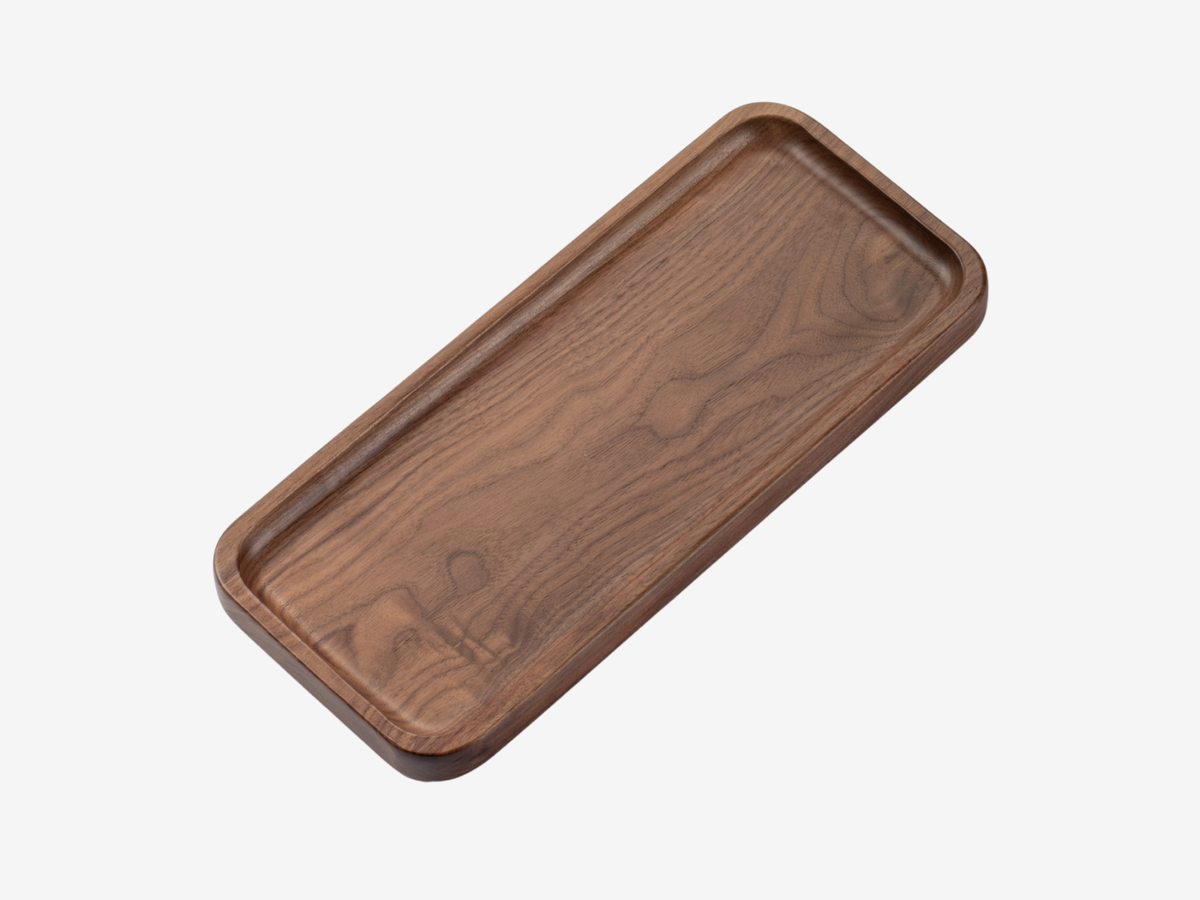
A walnut tray can bring coffee cups, keys, or small desk essentials together, but a good fit depends on the items you use. Before choosing a tray by its photo or headline length, measure the whole arrangement and check which product measurements are actually provided.
This guide uses a paper-layout method you can repeat at home. It does not assume a particular cup capacity or treat the tray's listed dimensions as its usable inner dimensions.
Start with the items, not the tray
Choose one everyday task: a coffee cup and small dish, a tea setup, or an organized place for keys and jewelry. Put the actual items together on the surface where the tray will sit. Include saucers, spoon rests, and handles rather than measuring only the bottom of a cup.
Arrange everything as you would use it. Leave enough room to take hold of a handle or lift a small object without moving the whole arrangement. Trace around the complete setup on paper and note its length and width. There is no universal clearance number: the space you need depends on your objects and how you reach for them.
Read three different measurements separately
- Listed tray dimensions: the measurements published on the product page. Check whether they are identified as outside or inside dimensions.
- Usable inner area: the flat area available for your objects. A raised rim, sloped side, or rounded corner can reduce this space.
- Tabletop footprint: the area the tray takes up on a desk, shelf, or coffee table, including room around it for normal use.
A paper outline drawn from listed dimensions helps you judge the tray's approximate presence on your table. It does not establish whether a cup base will fit inside the rim. If usable inner measurements are missing and your layout is tight, ask us for the needed measurement before ordering.
Compare the listed Musowood walnut tray sizes
The figures below reproduce the dimensions currently listed on the product pages. They are not confirmed usable inner dimensions and should not be used to calculate cup capacity.
| Tray | Listed size in cm | Listed size in inches |
|---|---|---|
| Rectangular walnut serving tray | 29.97 × 12.95 × 2.03 | 11.8 × 5.1 × 0.8 |
| Curved-edge walnut tray, small | 25 × 13 × 2 | 9.8 × 5.1 × 0.8 |
| Curved-edge walnut tray, large | 30 × 16 × 2 | 11.8 × 6.3 × 0.8 |


The rectangular tray and large curved-edge tray have similar listed lengths, but different listed widths. Length alone is therefore a poor way to choose between them. Match the shape and width to your arrangement, then confirm the usable inner area where necessary. Metric and inch values are rounded as published.
Choose a shape for your arrangement
A long rectangular layout may suit objects placed in a row. A wider layout may be worth comparing when you want items side by side. Rounded corners can affect objects placed near the edge, so do not compare the full bounding rectangle with a tightly packed arrangement and assume every corner is usable.
For desk organization, decide what belongs on the tray and what still needs its own space. A tray should not force you to reach over a drink to use a keyboard or take a frequently used object. Try the paper layout on the real surface before you buy.
Check the setup before daily use
- Confirm that each object has a level resting position inside the tray.
- Check that the rim does not interfere with a wide cup base, handle, or dish.
- Keep room around the tray for your normal hand movements and nearby objects.
- For coffee service, arrange drinks in cups and food on suitable dishes.
- Recheck the arrangement when changing cups or adding accessories.
Wood grain and color naturally vary, so use product photos to understand the shape and overall appearance rather than expecting an identical grain pattern.
Keep a measurement checklist
Open the printable tray fit checklist and record your objects, arrangement size, tray variant, and any inner measurements still needed. The checklist is a worksheet, not a scale template.

Frequently asked questions
How many cups fit on an 11.8-inch tray?
There is no reliable answer from length alone. Cup bases, handles, saucers, the tray width, and its inner shape all matter. Measure your actual arrangement and confirm the usable inner area.
Can I use a serving tray as a desk organizer?
It can group small everyday items on a tabletop. Check the footprint against your desk and make sure frequently used objects remain easy to reach.
Should I choose the larger tray automatically?
No. A larger footprint may take space needed for something else. Choose the option that fits your arrangement and the real surface where you plan to use it.
When your measurements are ready, compare the serving trays collection. Keep any unconfirmed inner dimensions on your checklist instead of guessing.


Leave a comment
This site is protected by hCaptcha and the hCaptcha Privacy Policy and Terms of Service apply.