

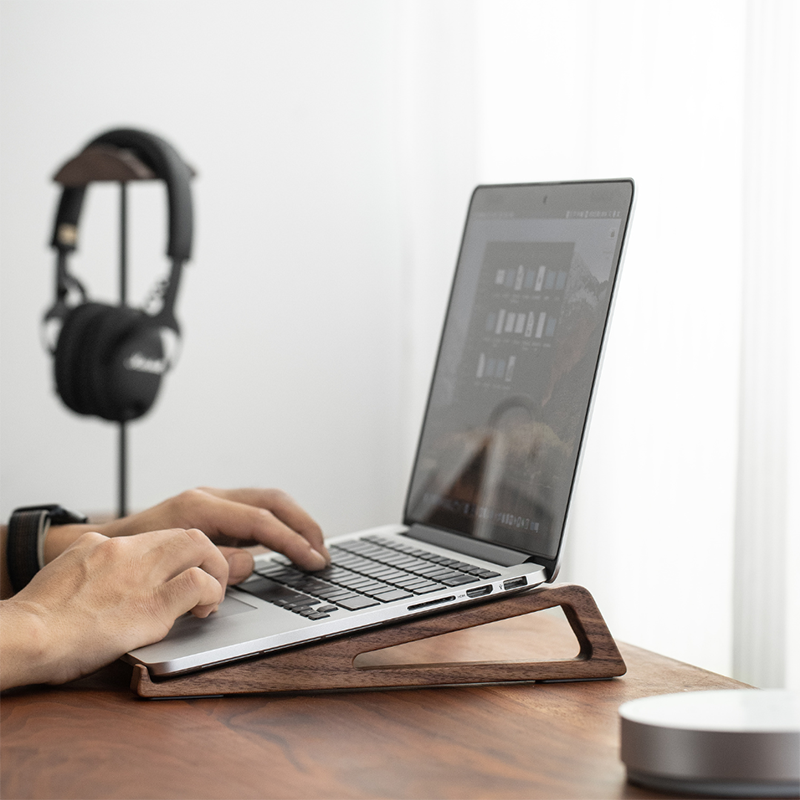
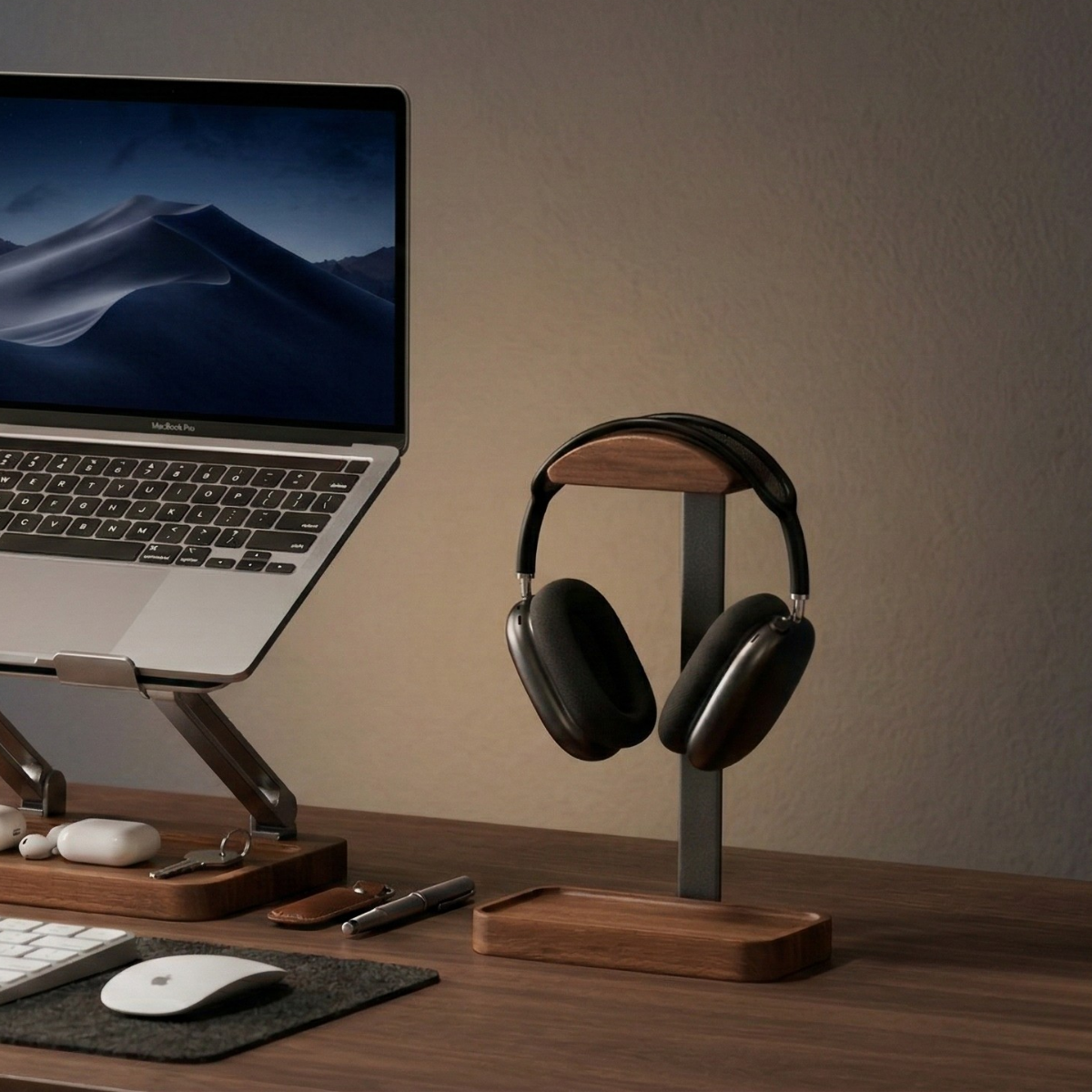
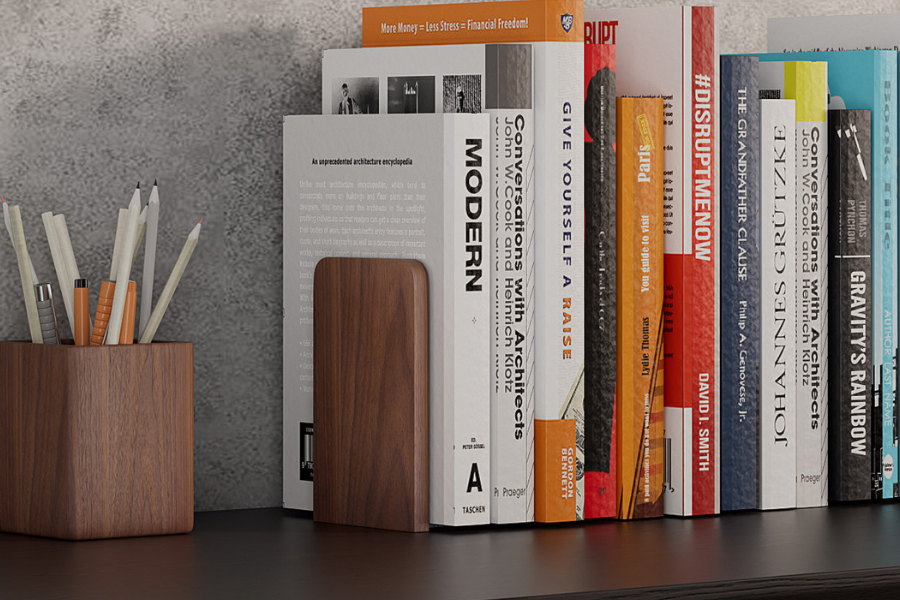
Wooden bookends keep a reading row upright on a shelf or desk without asking the furniture to do more than it can. The useful choice starts with the books you already keep together, the depth of the shelf, and how the bases will sit—not with a claimed book count.
This buying guide covers what wooden bookends are for, how to measure before you buy, how wood compares with other materials, when a pair is enough, and how to match a profile to your space. For step-by-step placement after you already have a pair, see our shelf fit and setup guide.
What wooden bookends are for
Wooden bookends brace the ends of a short row of books, notebooks, or folders. They belong on a level shelf or desk surface where both bases can rest fully on the support.
They do not raise a shelf’s load rating. The shelf and its brackets still carry the weight. They also do not replace a case or cabinet when you need enclosed storage.
On a desk, a compact pair can hold the books you reach for during the day. On a bookshelf, the same idea applies to one section of a longer run: keep that section upright, and leave the rest of the shelf to whatever system you already use. Shelf bookends work best when the row is intentional—a set you return to—rather than every volume on the wall.

Measure shelf depth, clear height, and the book row
Before comparing styles, measure three things in the same units (inches or centimeters):
- Shelf depth — the usable depth from front edge to back. Your bookend footprint and the book bases must fit without hanging over the edge.
- Clear height — the open height under the shelf above (or under a cabinet). Tall upright panels need this clearance.
- The row you will keep together — stand those books upright and measure the width of that group. This is planning width, not a capacity rating.
Also note the tallest book’s height and whether spines vary a lot. Mixed heights are normal; the bookends only need to brace the end volumes so the row stays upright.
Product listings sometimes give two dimensions for a wood panel. That is not always a complete assembled footprint. If a missing measurement decides whether the pair will fit a tight shelf, confirm it before ordering. Write the three measurements down; guessing from a photo alone is how pairs end up too deep or too tall for the bay.
Wood bookends versus metal, acrylic, and stone
Material changes weight, look, and how the piece meets the shelf:
- Wood — Warm grain, often paired with a metal base on desk-friendly designs. Natural tone and grain vary from piece to piece. Suitable when you want the bookends to sit visually with other wood desk accessories.
- Metal — Often heavier for a given size; can suit industrial shelves. Edges and finish matter if books slide against them often.
- Acrylic or resin — Light and visually quiet; may need more footprint or mass for taller, heavier volumes.
- Stone — High mass in a small footprint; check shelf load limits carefully.
There is no single best material. Match mass and footprint to the books and the shelf, then choose the finish that fits the room. Walnut bookends, beech, acacia, and sapele each read differently next to oak shelves or a walnut desk—compare product photographs and allow for natural variation between individual pieces.
If you already use walnut trays or stands on the same desk, a walnut pair keeps the materials family consistent. That is a styling preference, not a performance rule.
Pair versus set: what you actually need
Most wooden bookends for home shelves and desks are sold as a pair: two matching ends for one row. That is enough for one reading group.
Add another pair when you keep a second, separate row—another shelf, the other side of a desk, or a different book size you do not want mixed in. Buying a larger “set” only helps if you already know you need two separate rows.
Avoid stacking more books than the shelf surface and your own stability check support. A larger wood panel alone does not mean a higher safe book weight. No universal book count applies across titles, paper stocks, and shelf finishes.
Shape and footprint: matching style to the shelf
Once measurements are clear, compare profile and listed size. The figures below are current Musowood listing measurements—a starting point for comparison, not tested capacity ratings or a guarantee of every unlisted axis.
-
Compact L-shaped / small rectangular — Smaller listed panel (about 5.12 × 3.15 in / 13 × 8 cm). Useful on a desk or a shallow shelf when space is tight. Wood options may include walnut, beech, or sapele. Product: Small Wooden Bookends — Pair.

-
Larger rectangular L — Larger listed size (about 7.09 × 4.72 in / 18.01 × 11.99 cm) with walnut panels, iron bases, and foam pads. Choose when you want a taller visual brace and have confirmed depth. Product: Rectangle Bookends L.

-
Oval — Rounded silhouette (about 5.51 × 4.72 × 4.25 in / 13.99 × 11.99 × 10.80 cm) in walnut or beech with metal bases. Useful when you want a softer outline on an open shelf. Product: Wooden Oval Bookends.

-
Thicker triangular wood with iron base — Heavier visual mass; listed wood about 5.98 × 3.66 × 1.26 in / 15.19 × 9.3 × 3.2 cm, with a separate iron length of about 3.62 in / 9.19 cm. Confirm any unlisted assembled footprint on a tight shelf. Product: Thick Wooden Bookends — Pair.

Browse all current pairs in the wooden bookends collection.
Styling tips that stay practical
Keep the most-used books toward the end of the row you open most often, so you are not fighting the far bookend every time you take one out. Align spines roughly; perfect flush edges are optional.
Leave a little free space at the front of the shelf so bases are not perched on the lip. On open shelves, one calm pair often looks better than mixing three different shapes in the same bay.
Pair wood tone with nearby trays or laptop stands only if you like a coordinated desk—not because matching is required. Plain wooden bookends and minimalist profiles tend to disappear into the shelf; thicker or oval faces read more as objects. Choose the level of presence you want before you choose the wood species.
When Musowood wooden bookends are a fit
Choose a Musowood pair when you want solid wood panels with metal bases, sold as a matching pair, and you are willing to check listed sizes against your shelf first.
Natural wood grain and tone vary. No maximum supported book weight is published for these pairs—use your own row and a stable surface rather than a universal capacity claim. If a dimension you need is not listed, ask before ordering.
For placement details after purchase, use the fit and setup guide.
To compare sizes, woods, and profiles in one place, open the wooden bookends collection and pick the pair that matches the shelf you measured.

Leave a comment
This site is protected by hCaptcha and the hCaptcha Privacy Policy and Terms of Service apply.