

A pair of bookends can keep a reading row together on an existing desk or shelf. Choosing and using them starts with the books, the available shelf space, and the way the bases sit beneath the end books—not with a promised number of books.
Printable bookend measuring worksheet
Record your book row, shelf depth and clear height, then compare four current pairs using real product photos and the listed dimensions. The worksheet identifies missing footprint details rather than assuming them.
Download the free bookend measuring worksheet (PDF, 2 pages, approximately 1.3 MB)
Print on US Letter paper. This is a planning checklist, not a life-size footprint or a tested capacity rating.
1. Measure the row you actually use
Gather the books or folders you want to keep together and stand them upright on a level surface. Measure the width of that row, then check the space available on your shelf or desk. Measure shelf depth and the height beneath any shelf above it separately.
Record all three measurements in centimeters and inches. A product listing with two dimensions does not identify every part of a bookend, and a wood-panel measurement is not automatically the complete base footprint. If a missing measurement determines whether the bookend will fit, ask us to confirm it before ordering.
2. Check where the bases will sit
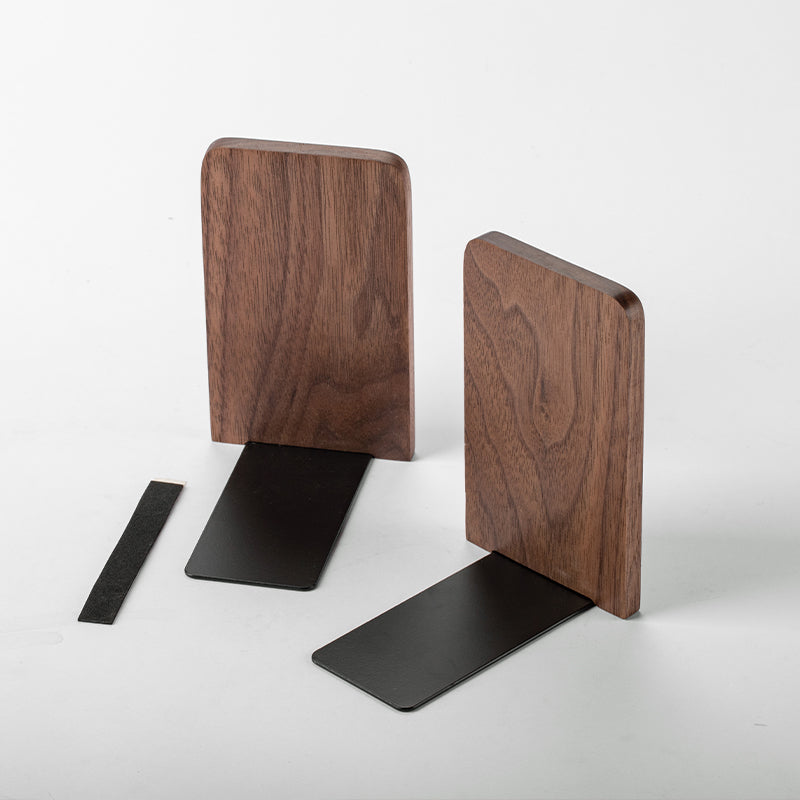
For an L-shaped bookend, position the base beneath the book at the end of the row, with the upright panel against that end book. Use the second bookend at the other end. Keep the bases fully on the supporting surface rather than hanging over its edge.
Set the row upright and bring the ends together without forcing or bending the covers. If books lean, the ends move, or a base rocks, reduce or rearrange the row and check the surface. Do not assume that adding more pressure will make an unstable arrangement suitable.
3. Choose a shape using the listed measurements
The following are current Musowood listing measurements. They are a starting point for comparison, not tested capacity ratings or confirmation of every measurement axis.
- Small rectangular pair: walnut, beech, or sapele; listed size 13 × 8 cm / 5.12 × 3.15 in. This two-axis size does not specify a complete footprint.
- Large rectangular walnut pair: walnut panels, iron bases, and foam pads; listed size 18.01 × 11.99 cm / 7.09 × 4.72 in. Confirm any unlisted dimension needed for a tight shelf.
- Oval pair: walnut or beech with metal bases; listed size 13.99 × 11.99 × 10.80 cm / 5.51 × 4.72 × 4.25 in.
- Thick wooden pair: walnut or acacia with iron bases and non-slip pads. Listed wood dimensions are 15.19 × 9.30 × 3.20 cm / 5.98 × 3.66 × 1.26 in; the separate iron measurement is 9.19 cm / 3.62 in. These component measurements are not a full assembled footprint.
 Small rectangular bookendsView product
 Large rectangular bookendsView product
 Oval bookendsView product
 Thick wooden bookendsView product
Each linked listing describes a pair: two bookends. Choose the shape and wood option you prefer after checking the available space. A larger-looking panel alone does not establish a higher supported book weight.
4. Leave room to take a book out
Try the arrangement with a book you reach for often. Support the neighboring books as you remove it, then reset the row and the bookend. Recheck the arrangement when adding a tall folder, a different-size book, or another item. Keep frequently used books within an easy reach rather than squeezing the row into every available centimeter.
Questions to resolve before you buy
How many books can a pair hold?
There is no verified fixed number in this guide. Book size, weight, surface, spacing, and arrangement vary. Use your own row measurements and check its stability rather than relying on a universal capacity claim.
Can bookends increase my shelf's load capacity?
No. The shelf and its supports remain responsible for carrying the books. Follow the shelf maker's limits.
Do I need to match the wood color exactly?
Natural wood grain and tone vary. Compare the listed wood options and product photographs, allowing for variation between individual pieces.
Still choosing a pair? Start with our wooden bookends buying guide for size, material, and footprint tips.
Browse the wooden bookends collection to compare the current pairs. For broader desk planning, see our small desk setup guide.


Leave a comment
This site is protected by hCaptcha and the hCaptcha Privacy Policy and Terms of Service apply.